
Supercritical CO₂ vs. Ethanol Extraction: A Technical Comparison
Category: Technology | Published: October 2024 | Read Time: 10 min
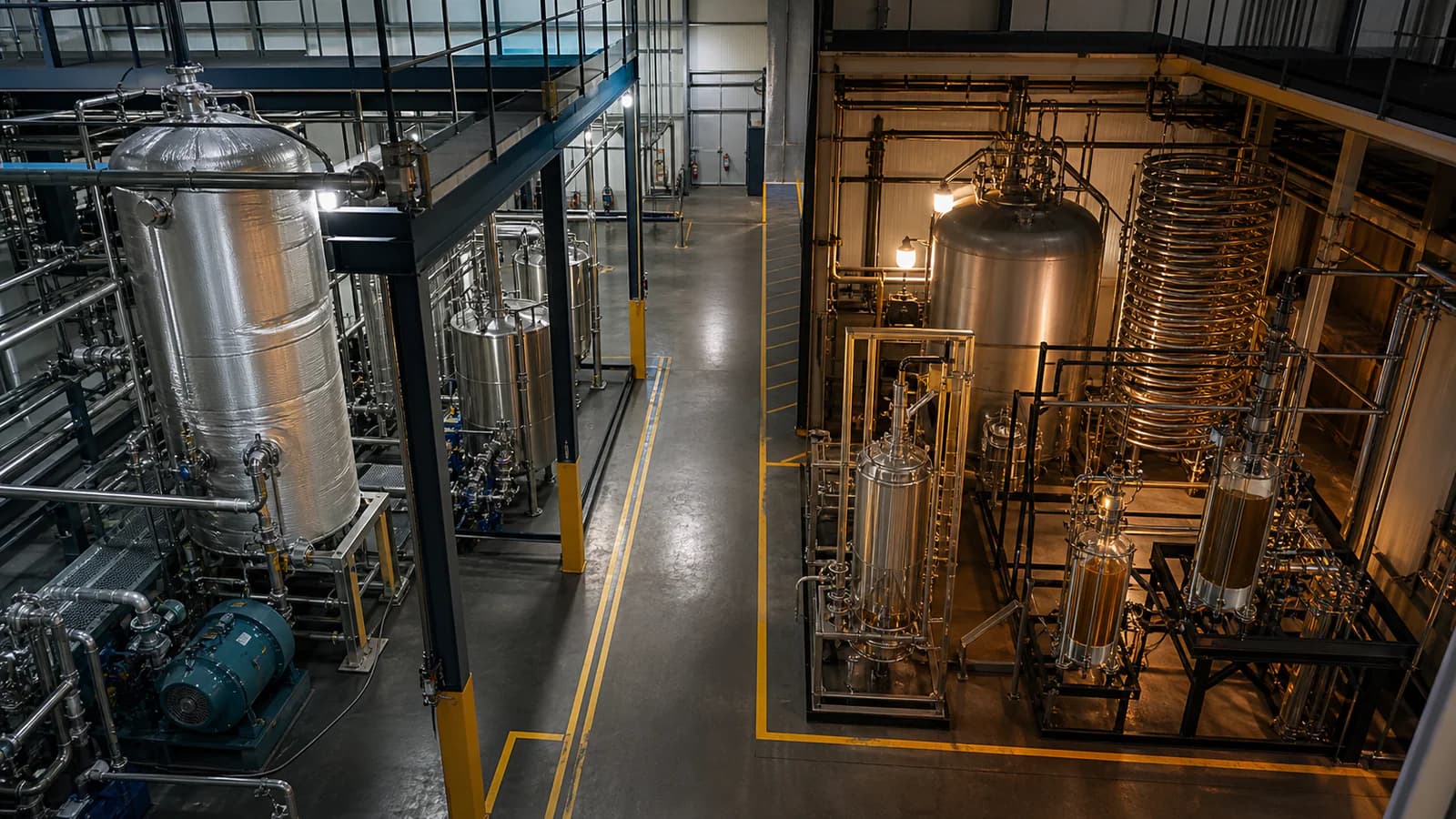
The choice of primary extraction solvent is the most consequential technical decision in CBD manufacturing. It determines not only the purity profile of the final isolate but also the economics of scale, the regulatory documentation burden, and the range of downstream products that can be derived from the crude extract. For industrial buyers procuring at multi-kilogram to metric-ton quantities, understanding the technical tradeoffs between supercritical CO₂ and ethanol extraction is foundational to supplier qualification.
This analysis presents a rigorous head-to-head comparison across the dimensions most relevant to B2B procurement: purity, scalability, solvent residues, terpene preservation, and total cost of operation.
Extraction Mechanism: Fundamentals
Supercritical CO₂ extraction exploits a physical phenomenon: at temperatures above 31.1°C and pressures above 73.8 bar, CO₂ enters a supercritical state exhibiting the solvation properties of a liquid with the diffusivity of a gas. By tuning temperature and pressure, operators can selectively extract target compounds with high specificity. Cannabinoids, for instance, are most efficiently extracted at 45–65°C and 200–350 bar.
Ethanol extraction relies on ethanol's broad-spectrum solubility. As a polar solvent with amphiphilic properties (containing both a nonpolar ethyl group and a polar hydroxyl group), ethanol dissolves cannabinoids, chlorophyll, waxes, and a wide range of water-soluble compounds simultaneously. The crude extract requires extensive post-processing—winterization, decarboxylation, distillation—to achieve final product purity.
Purity Profiles: Head-to-Head Data
The purity achievable at each extraction stage differs significantly between methods:
Scroll horizontally to view the full table.
| Parameter | Supercritical CO₂ (Crude) | Ethanol (Post-Winterization) |
|---|---|---|
| Total Cannabinoids | 60–75% | 55–70% |
| Residual Chlorophyll | <0.01% | 0.1–0.8% |
| Residual Waxes/Lipids | <0.5% | 0.5–3.0% |
| Water-soluble Impurities | Negligible | 1–5% |
| Terpene Retention | 2–8% (tunable) | <1% |
After full refinement to isolate grade (99%+ CBD), both methods can achieve comparable final purity. The difference emerges in the refinement burden: CO₂ crude requires fewer downstream processing steps, while ethanol crude requires more extensive remediation of co-extracted impurities.
Chlorophyll content is particularly instructive. The dark green color of ethanol crude extracts is caused by chlorophyll co-extraction—a consequence of ethanol's broad polarity. While chlorophyll is removed during subsequent processing, the additional filtration and adsorption steps (activated carbon treatment is common) introduce:
- Additional processing cost (~$8–15/kg CBD equivalent)
- Risk of target compound adsorption losses (CBD losses of 2–5% are typical)
- Additional quality testing burden
CO₂ extraction's lower chlorophyll co-extraction reflects the selectivity advantage of a tunable supercritical solvent.
Scalability Analysis
This is where the comparison becomes commercially decisive for large-volume buyers.
Ethanol extraction scales more readily at high throughput. Industrial centrifugal extractors can process 2,000–5,000 kg of biomass per hour, making ethanol the dominant technology in large US extraction facilities optimized for volume. The capital cost per unit of throughput is lower than CO₂ at extreme scales.
CO₂ extraction offers superior throughput efficiency at pharmaceutical-grade targets. While individual CO₂ vessels are smaller (typically 50–500L), high-pressure systems can run multiple vessels in parallel with automated cycling. Critically, the lower post-processing burden means that equivalent final isolate output requires less downstream equipment—partially offsetting the higher upstream capital cost.
Regulatory scalability favors CO₂ decisively. Ethanol is classified as a Class 3 solvent under ICH Q3C guidelines, with an acceptable daily intake of 5,000 mg/day. However, regulatory authorities in multiple jurisdictions (particularly in APAC) scrutinize ethanol-extracted CBD more intensively than CO₂-extracted CBD, creating compliance friction that increases with market regulatory maturity.
Solvent Residues: Regulatory Risk Quantification
CO₂ extraction produces zero solvent residues. CO₂ is a naturally occurring atmospheric gas, and at ambient pressure, it dissipates completely from the extract. This property eliminates an entire category of quality testing (residual solvent analysis), simplifies regulatory documentation, and positions CO₂-extracted CBD as the preferred input for pharmaceutical API applications.
Ethanol extraction requires rigorous residual solvent testing at each processing stage:
- Post-extraction crude: Ethanol levels typically 500–2,000 ppm
- Post-winterization: 100–500 ppm (specification varies by downstream use)
- Post-distillation isolate: <5,000 ppm (ICH Q3C Class 3 limit)
- Pharmaceutical API specification: ≤500 ppm (common internal specification)
The testing cost for residual solvents at scale—batch-level GC/FID analysis—adds approximately $50–150 per batch. At high production volumes (100+ batches/year), this is a non-trivial quality cost.
More importantly, residual ethanol creates a regulatory conversation that CO₂-extracted CBD avoids entirely. For B2B buyers supplying pharmaceutical customers or regulated APAC markets, this distinction is commercially material.
Terpene Preservation: Spectrum Products vs. Isolate
Terpene preservation is the one dimension where the comparison requires qualification based on intended end use.
For full-spectrum and broad-spectrum products, CO₂ extraction offers significant advantages. By operating at lower temperatures and adjusting pressure selectively, CO₂ systems can preserve terpene fractions that would be volatilized during ethanol processing. Select terpene-rich fractions can be captured in a separate low-pressure separator and recombined with the cannabinoid-rich fraction—producing "live resin" style full-spectrum extracts with authentic terpene profiles.
For CBD isolate (99%+ pure CBD), terpene preservation is irrelevant. All terpenes are removed during crystallization. Both extraction methods produce equivalent isolate when terpene content is the metric.
For a supplier like Vetrux CBD operating at pharmaceutical-grade isolate specifications, CO₂ extraction's terpene advantage is most relevant to the broad-spectrum product line rather than the primary isolate grade product.
Total Cost of Operation: A Realistic Model
Capital cost comparisons frequently drive early conversations between procurement teams and extraction technology vendors. But capital cost is only one component of the true cost of ownership.
Indicative cost model (per kg CBD isolate produced, at 1,000 kg/year scale):
Scroll horizontally to view the full table.
| Cost Category | CO₂ Extraction | Ethanol Extraction |
|---|---|---|
| Capital amortization (10yr) | $85–120 | $45–75 |
| Energy (electricity/cooling) | $25–45 | $35–60 |
| Solvent cost (makeup) | $5–8 | $30–55 |
| Post-processing labor | $20–35 | $40–65 |
| Residual solvent testing | $0 | $8–15 |
| Chlorophyll remediation | Minimal | $8–15 |
| Regulatory documentation | Standard | Enhanced |
| Total (approximate) | $135–208 | $166–285 |
Note: These figures are illustrative and vary significantly with biomass quality, facility location, energy cost, and product specification. At very high throughput (>10,000 kg/year CBD isolate), ethanol economics improve substantially due to lower capital amortization per unit.
Our Position
Vetrux CBD operates a dedicated supercritical CO₂ extraction fleet for pharmaceutical-grade CBD isolate production. This is not an arbitrary technology choice—it reflects a deliberate positioning at the quality apex of the B2B CBD extract market.
Our customer base—pharmaceutical API manufacturers, premium wellness brands, and regulated health products—consistently places solvent residue documentation, regulatory acceptance, and purity at the top of supplier qualification criteria. CO₂ extraction is the technology that delivers these outcomes most reliably.
For buyers evaluating CBD extract suppliers, the technology question translates to a practical due diligence checklist:
- What is the primary extraction method? (CO₂, ethanol, hydrocarbon, other)
- What is the residual solvent specification and testing frequency?
- Is the extraction system cGMP-compliant and independently audited?
- What post-processing steps are employed? (winterization, distillation, crystallization)
- Can the supplier provide batch-level COAs demonstrating technology consistency?
The answers to these questions reveal far more about final product quality than the stated purity specification on a product datasheet.
Vetrux CBD operates 12 supercritical CO₂ extraction vessels with a combined annual capacity of 8 metric tons of CBD isolate. Technical specifications and process validation documentation are available to qualified B2B partners.
About the publisher
VETRUX Technical Content Team
CBD raw-material and sourcing context
VETRUX publishes practical material-handling, documentation, and supplier-qualification guidance from the perspective of a CBD raw-material supplier in Chuxiong, Yunnan.
Learn more about VETRUX →

